
Why Emotional Awareness for Growth Matters
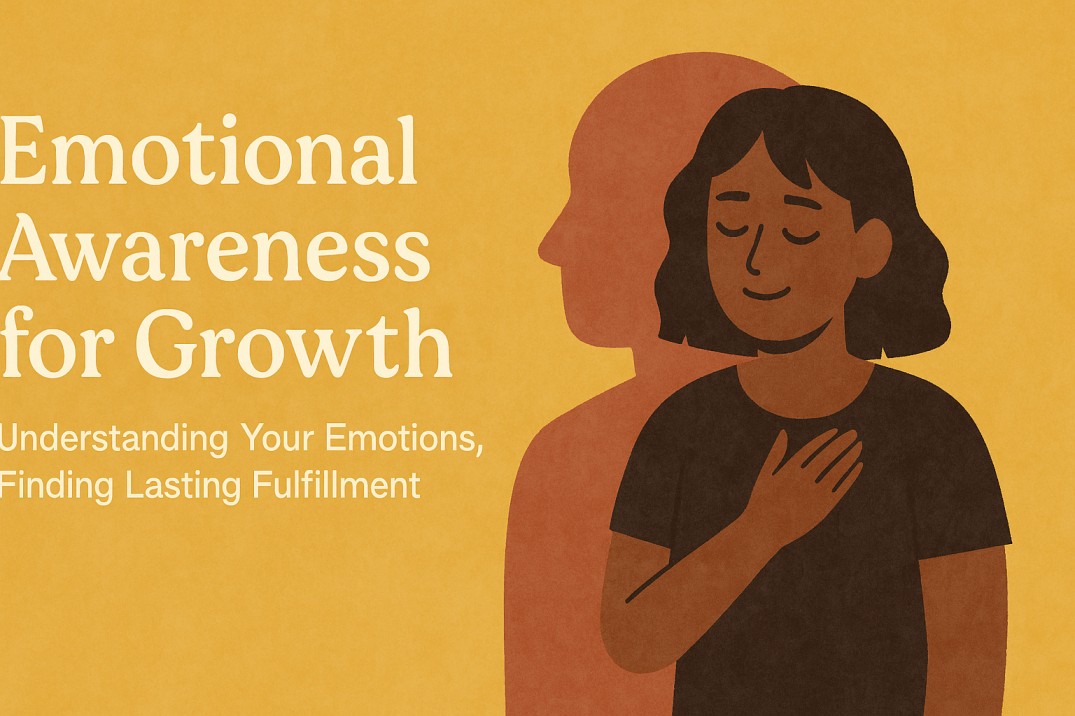
Emotional awareness for growth is the core of meaningful self-change.
When you understand what you feel, why you feel it, and how those feelings shape your choices, you gain the power to direct your inner world instead of being directed by it.
Many people chase transformation through strategies, habits, and productivity — but real growth begins with recognizing your emotional patterns. Emotional awareness for growth helps you slow down, reflect, and respond with clarity instead of reacting out of past wounds or unconscious habits.
This guide explores five reflective practices that gently build emotional awareness for growth, helping you understand yourself deeply and live with grounded intention.
1. Observe Your Emotions Without Judgment
One of the foundations of emotional awareness for growth is learning to sit with your emotions exactly as they are — without labeling them as good or bad.
Most emotional pain comes not from the emotion itself, but from the resistance to feeling it.
Instead of saying “I shouldn’t feel this,” try saying, “This is what I’m feeling right now.”
This shift turns conflict into clarity.
Reflective Practice:
Each time a strong emotion arises, pause for a few seconds and name it:
“This is sadness.”
“This is irritation.”
“This is disappointment.”
Naming the feeling reduces emotional intensity and gives your mind space to understand what the emotion is trying to communicate.
Observing without judgment teaches your nervous system safety — the foundation of emotional awareness for growth.
2. Follow Your Feelings Back to Their Source
Emotional awareness for growth means going deeper than the surface emotion.
Anger often hides hurt.
Frustration often hides unmet needs.
Sadness often hides exhaustion or loneliness.
When you trace emotions back to their origin, you gain insight that transforms your reactions.
Reflective Practice:
Ask yourself three gentle questions any time you feel overwhelmed:
- What triggered this feeling?
- What need or value of mine feels threatened?
- Is this emotion new or familiar?
These questions bring clarity to patterns you may have ignored.
Understanding the source is what turns emotional reactions into emotional wisdom.
3. Use Journaling to Process Inner Dialogue
Writing is one of the most powerful tools for emotional awareness for growth.
Your thoughts become clear when they move from the mind onto the page.
Journaling slows down the mind and reveals emotional truths that are often buried beneath routine thinking.
You don’t need long entries — honesty matters more than length.
Reflective Practice:
Write freely for five minutes each morning or night.
Use prompts like:
- “What emotion stayed with me today and why?”
- “What did I avoid feeling?”
- “What does my heart need from me right now?”
This simple ritual builds emotional clarity day by day.
Over time, journaling becomes a mirror that shows not just how you feel, but who you’re becoming.
4. Practice Emotional Labeling Throughout the Day
Emotional awareness for growth doesn’t only happen during deep reflection — it also grows in small moments.
Throughout your day, your feelings shift constantly.
The more aware you become of these shifts, the easier it becomes to manage your reactions.
Reflective Practice:
Set a reminder on your phone for three random times during the day.
When it appears, ask yourself:
“What am I feeling in this moment?”
This mini check-in trains your brain to stay connected to your emotional state.
It prevents your feelings from building silently and exploding later.
Frequent labeling builds a stable relationship with yourself.
5. Separate the Emotion From the Story
Emotional awareness for growth also means understanding that emotions and the stories we attach to them are not the same.
For example:
Feeling ignored → Story: “People don’t value me.”
Feeling uncertain → Story: “I’m not capable.”
When you separate the raw emotion from the narrative, you remove distortion and access truth.
Reflective Practice:
When you feel overwhelmed, ask:
- “What am I feeling?”
- “What story am I adding to this feeling?”
This creates space between emotion and interpretation.
That space is where healing begins.
Emotional awareness for growth begins with understanding your inner world — observing emotions, tracing their origins, and creating clarity through reflection. As your awareness deepens, the next step is learning how to work with your emotions more consciously through identity, environment, and gentle internal shifts that support long-term emotional balance.
Deepening Emotional Awareness for Growth Through Identity, Environment, and Inner Alignment
Emotional awareness for growth expands when you understand that your inner world is shaped not only by your feelings, but also by your identity, your habits, and the environment you move through. Once you learn to recognize your emotions, the next step is learning how to support them — through conscious choices, safe spaces, and self-alignment.
These deeper practices help emotional awareness move from a moment of clarity into a long-term transformation.
6. Align Your Identity With Emotional Growth
A powerful part of emotional awareness for growth is recognizing that your identity influences how you interpret your emotions.
If you see yourself as “someone who always struggles,” every emotion becomes heavy.
If you see yourself as “someone who is learning,” every emotion becomes information.
Identity shapes the meaning of your feelings.
Reflective Practice:
Finish this sentence at the end of each day:
“Today, I showed up as someone who is learning to…”
Examples:
- “…create calm.”
- “…listen to myself.”
- “…respond with softness.”
This tiny identity shift helps you meet your emotions with compassion instead of criticism.
Growth begins where self-understanding replaces self-judgment.
7. Design an Environment That Supports Your Emotional Clarity
Your physical environment strongly influences emotional awareness for growth.
Clutter clouds your mind.
Noise disrupts self-connection.
Bright screens drain focus.
A supportive environment creates emotional calm before you even begin any reflective practice.
Reflective Practice:
Choose one small area — your nightstand, desk, or a corner of your room — and turn it into your “awareness space.”
Keep it simple:
- A journal
- A soft light
- One calming object (plant, stone, candle)
This becomes the place you return to when you need to reconnect with yourself.
A consistent environment teaches your body to relax and your mind to open.
8. Slow Down the First and Last 10 Minutes of Your Day
Emotional awareness for growth thrives in slowness.
Most emotional misalignment comes from rushing — rushing into the day, rushing through reactions, rushing into decisions.
When the first and last 10 minutes of your day are slow and intentional, your emotions settle and become easier to understand.
Reflective Practice:
Morning: Breathe, hydrate, stretch, observe how you feel.
Night: Reflect, release thoughts, name what you learned emotionally that day.
These two daily windows become emotional anchors, preventing you from being carried away by the world’s pace.
9. Create Emotional Pauses During Your Day
A major part of emotional awareness for growth is learning to pause before reacting.
The pause is where wisdom lives.
It is the space between sensation and reaction, and it determines the quality of your choices.
Reflective Practice:
Whenever you feel tension rising, pause for 5 seconds.
Place your hand on your chest or belly.
Ask yourself softly:
“What is actually happening inside me right now?”
This short pause prevents emotional spirals and builds emotional maturity.
Over time, your reactions transform into thoughtful responses.
10. Revisit Your Emotions With Curiosity, Not Control
Emotional awareness for growth doesn’t require perfect emotional regulation — it requires curiosity.
Trying to “control” your feelings creates pressure.
Curiosity opens space.
It lets you explore your emotional landscape without fear.
Reflective Practice:
When you feel something difficult, ask:
- “What is this emotion trying to teach me?”
- “Where do I feel it in my body?”
- “What does this emotion need from me right now?”
Curiosity softens intensity.
It turns emotions into teachers instead of threats.
It makes growth accessible even on hard days.
At this stage, you’ve learned how emotional awareness for growth expands through identity shifts, supportive environments, and gentle daily rhythms. The final step is understanding how mindfulness, gratitude, and emotional integration turn this awareness into a stable inner foundation — one that supports lifelong calm, resilience, and meaningful self-development.
Integrating Mindfulness, Gratitude, and Emotional Intelligence for Lifelong Growth
Emotional awareness for growth becomes truly transformative when it evolves from a reflective practice into a lived experience.
This happens when mindfulness, gratitude, and emotional intelligence blend into your everyday moments — shaping how you think, respond, and carry yourself through the world.
These final practices bring everything together, helping your emotional awareness turn into a long-term, grounded way of living.
11. Use Mindfulness to Anchor Your Emotional Awareness
Mindfulness is the stabilizing force behind emotional awareness for growth.
It teaches you to stay present with your emotions instead of getting lost in them.
When you notice your feelings as they happen, you gain the freedom to choose your response rather than fall into old patterns.
Mindfulness doesn’t require silence or stillness — only awareness.
Reflective Practice:
Take one mindful breath before you:
- Reply to a message
- Step into a room
- Begin a conversation
- Make a decision
That single breath interrupts emotional autopilot and brings you back to intentional awareness.
Over time, mindfulness creates emotional reliability — the ability to stay grounded even when life becomes unpredictable.
12. Use Gratitude to Shift Emotional Patterns
Gratitude is one of the most powerful companions to emotional awareness for growth.
It gently redirects the mind away from fear, comparison, or scarcity — and back toward presence and emotional abundance.
When gratitude becomes a daily practice, it shapes how you interpret your emotions.
Even difficult feelings soften under its influence.
Reflective Practice:
Write one line each morning or night:
“Today I am grateful for…”
Choose something simple — sunlight, rest, a conversation, or the strength to keep going.
Gratitude doesn’t deny your emotions; it balances them.
It helps you hold joy and discomfort together without collapsing into negativity.
13. Build Emotional Vocabulary Through Daily Reflection
A key part of emotional awareness for growth is developing a richer emotional vocabulary.
When you can identify subtle emotions — not just “good” or “bad” — you deepen your understanding of yourself.
Most people feel emotions they cannot name.
Naming brings clarity.
Clarity brings intelligence.
Reflective Practice:
Expand your emotional language with words like:
- Overwhelmed
- Tender
- Restless
- Hopeful
- Vulnerable
- Recharged
- Detached
Use these during your daily check-ins.
Over time, your reflections will become more precise, more truthful, and far more healing.
14. Practice Emotional Integration, Not Emotional Perfection
Many people misunderstand emotional awareness for growth and try to “fix” difficult feelings immediately.
But true awareness isn’t about eliminating emotions — it’s about integrating them with compassion.
Emotional maturity comes when you can feel sadness without collapsing into it, and feel joy without fearing its loss.
Reflective Practice:
When you feel a strong emotion, say:
“This emotion is valid. This emotion belongs. This emotion is part of me, not the whole of me.”
Integration creates inner balance — a harmony between opposing feelings.
This is where deep healing begins.
15. Carry Awareness Into Your Interactions
Emotional awareness for growth becomes powerful when it extends beyond your inner world and shapes how you show up with others.
When you understand your emotional landscape, you become a better listener, a clearer communicator, and a gentler presence.
Your inner work quietly influences your relationships.
Reflective Practice:
Before responding to someone, ask:
“Am I speaking from clarity or from emotion?”
This one question prevents emotional projection and strengthens emotional integrity.
The more aware you are of your own feelings, the more compassion you bring into your environment.
16. Review Your Emotional Patterns Monthly
Patterns reveal truth.
Monthly reflection strengthens emotional awareness for growth by helping you see what is changing and what still needs attention.
Your emotional journey is not linear — it expands, contracts, and evolves with your life seasons.
Reflective Practice:
At the end of each month, revisit your journal or notes.
Ask:
- What emotion appeared most often?
- What situation triggered the strongest reaction?
- Where did I show emotional growth?
- What needs care next month?
This practice prevents stagnation and keeps you aligned with your emotional needs.
17. Adapt Your Emotional Tools Over Time
Emotional awareness for growth requires flexibility.
What works today may not work next year, and that’s okay.
Your emotional needs evolve as your experiences evolve.
Some seasons need journaling.
Some need movement.
Some need silence.
Some need connection.
Reflective Practice:
Check in with yourself every few weeks and ask:
“Is my current way of processing emotions still helping me?”
Let your emotional tools shift with you, not against you.
18. Build a Gentle Relationship With Yourself
At its core, emotional awareness for growth is about developing a compassionate relationship with yourself.
You are not a project to perfect — you are a person to understand.
Growth becomes sustainable only when it is rooted in gentleness.
Reflective Practice:
End your reflection with a sentence of self-kindness:
“I am learning.”
“I am growing.”
“I am doing my best with what I know.”
Self-kindness is the emotional soil where all growth takes root.
19. Embrace Slowness as a Form of Strength
The world teaches urgency, but emotional awareness for growth teaches patience.
Slowness gives you space to observe, feel, and choose deliberately.
When you slow down, you stop living from emotional reflex and start living from emotional intention.
Reflective Practice:
When you feel rushed or pressured, slow down your speech, your breath, and your movements.
Let your body guide your mind back into presence.
Slowness is not weakness — it is grounded strength.
20. Allow Your Growth to Be Imperfect and Human
Emotional awareness for growth is never perfect.
You will have days of clarity and days of confusion.
Days of strength and days of sensitivity.
This ebb and flow is part of emotional intelligence.
Your emotions don’t need to be controlled — they need to be understood.
Embrace the journey with patience.
Your awareness will deepen.
Your reactions will soften.
Your inner world will become clearer and calmer over time.
Growth is not a straight line — it is a gentle becoming.
Final Reflection — Bean by Bean, You Grow Into Yourself
Emotional awareness for growth is the path back home to yourself.
By observing your emotions, tracing their origins, integrating mindfulness, and embracing imperfection, you cultivate a grounded inner life that supports your outer world.
You don’t need drastic change.
You only need honest attention, daily softness, and the willingness to feel.
One reflection.
One breath.
One small moment of awareness at a time.
Bean by bean, you grow into who you were always becoming.